The rule of thumb
The guidance almost everyone in fluid power hears first is that a reservoir should hold roughly three times the pump's output per minute. A pump moving twenty gallons a minute gets a sixty gallon tank. It is simple, memorable, and it produces reasonable answers for the kind of system it came from.
What the ratio is really doing is buying dwell time. If the tank holds three minutes' worth of flow, then on average a parcel of fluid gets something in the order of minutes in the tank before it is drawn back out, and minutes is roughly the timescale on which entrained air rises out of a mineral oil and heavy particulate falls out of suspension. The ratio is a proxy. Dwell time is the actual requirement.
Treat it as a first pass
Use the ratio to get a number on the page. Then run the three checks below. If they all agree with the ratio, you have a well-founded tank size rather than a guess that happened to be right. If they disagree, they are the ones to believe, because they are measuring the thing the ratio was standing in for.
Why it is debated
The three-times rule is contested not because it is wrong but because it is routinely applied outside the conditions it was calibrated in. It comes from open industrial power units running mineral oil at modest power density, where the tank was expected to do most of the cooling and floor space was cheap. Change any one of those assumptions and the ratio drifts.
- Mobile equipment runs much tighter. There is simply nowhere on an excavator or a truck to put a tank three times the pump flow. Mobile systems accept a much smaller ratio and compensate with a heat exchanger, harder-working internals and tighter filtration. This is a deliberate engineering trade, not a violation.
- High power density can demand more. A modern system pushing far more power through the same flow generates more heat per gallon. A tank sized on flow alone can be thermally undersized even at the classic ratio.
- Fluid type changes the timescale. Air release and settling behaviour vary between mineral oils, synthetics and fire-resistant fluids, and they vary with viscosity and temperature. The dwell time a fluid needs is a property of the fluid, not of the pump.
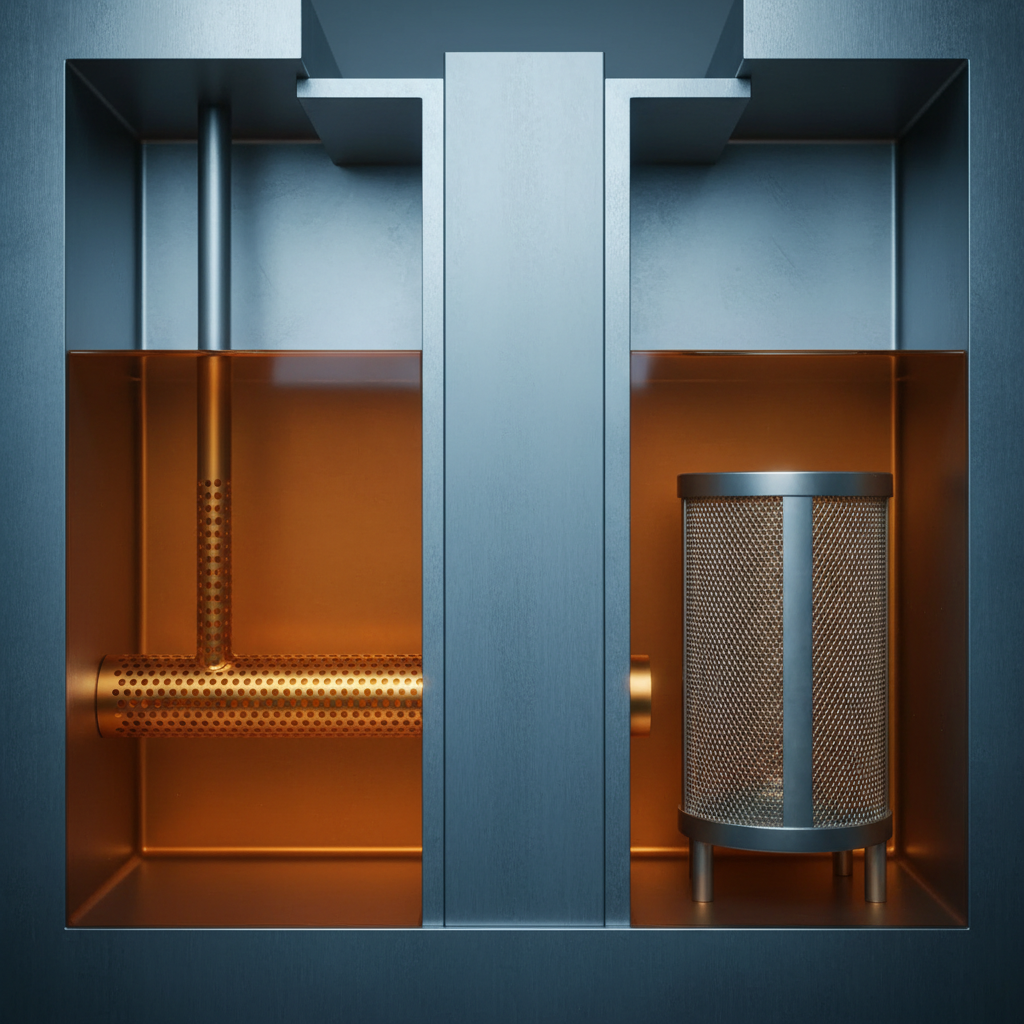
- Internal geometry can waste the volume entirely. A tank sized perfectly on paper and plumbed so the return discharges next to the suction line gives you a fraction of the dwell time you paid for. The ratio assumes a sensibly baffled tank and says nothing if that assumption fails.
- Cooling capacity is now cheap. Part of the historical case for a large tank was that a cooler was an expensive addition. Where a heat exchanger is readily available, the economics of solving a thermal problem with steel and fluid volume are much weaker than they were.
The three checks that actually decide it
1. Heat balance
Work out how much heat the circuit puts into the fluid at its worst realistic duty cycle. Every pressure drop that does not do useful work becomes heat: relief valve flow, throttling losses, pump and motor inefficiency, line and fitting losses. Then work out how much heat the tank can reject at the highest ambient temperature the installation will see, which is driven by exposed surface area, the temperature difference to ambient and how freely air moves around the tank.
If rejection cannot match generation at the target fluid temperature, the system needs a cooler. Growing the tank instead works badly: cooling scales with surface area while cost, fill volume, weight and footprint scale with volume, so each extra gallon buys progressively less cooling. Consult the fluid supplier and the component manufacturers for the operating temperature window your fluid and seals actually require rather than assuming one.
2. Dwell time for de-aeration
Estimate how long fluid genuinely stays in the tank, using the volume below the minimum fluid level and the path the baffling forces it to take, not the nameplate capacity. Compare that against the air release behaviour of the fluid you have specified at its operating temperature and viscosity. If the circuit shows foaming, spongy actuator response or noisy pump operation on a correctly sized tank, this check is usually where the problem is, and the fix is often internal geometry rather than more volume.
3. Swing volume and level extremes
A single-rod cylinder does not return the volume it takes. The rod occupies part of the bore, so extending draws more fluid out of the tank than retracting sends back, and the tank level moves every cycle. Add up the swing volume across every actuator that can move at once, in the worst-case combination, and confirm two things:
- At the lowest level the suction pickup stays submerged with margin, including at whatever working angle a mobile machine can reach, so the pump never draws air.
- At the highest level there is still air space above the fluid for thermal expansion, so fluid is not pushed out through the breather. That air space is a design requirement, not wasted tank.
Practical constraints that override the calculation
A number of real-world factors will change the answer regardless of what the arithmetic says, and they are worth surfacing before the tank is fabricated rather than after.
| Constraint | Effect on tank size |
|---|---|
| Available footprint | Often the binding constraint on stationary units. Going taller instead of wider preserves volume but reduces the useful settling area and can hurt de-aeration. |
| Weight and centre of gravity | Decisive on mobile and lifting equipment. Fluid is heavy, and a full tank high on a machine changes its stability. |
| Fluid cost and change-out | A large tank of an expensive fire-resistant or synthetic fluid is a significant recurring cost at every change interval. |
| Warm-up time | A big tank in a cold environment takes longer to reach operating viscosity, which is what drives the case for an immersion heater. |
| Cooler availability | If a heat exchanger is already in the design, the thermal argument for extra volume largely disappears. |
| Serviceability | Clean-out covers, drain access and breather height all need clearance around the tank, which competes with the volume itself. |
The short version
Start at three times pump flow. Check it against a heat balance, against the dwell time your fluid needs, and against swing volume at both level extremes. Let the checks move the number. Then make sure the internal geometry actually delivers the dwell time the volume implies, because a baffle plate is a far cheaper way to fix a hot, foaming system than another thirty gallons of tank.
Specific temperature limits, cleanliness targets and viscosity windows belong to your fluid supplier and your component manufacturers. Take them from the data sheets for the equipment in front of you.